Brief History
The Archaeological Museum of the Republic of North Macedonia presents movable cultural heritage, specifically around 7,000 archaeological artifacts discovered through excavations across the entire territory of the country since 1924. Thus, this museum represents the most significant and oldest museum institution in Macedonia.
Visitors can enjoy artifacts displayed in the departments of: Prehistoric Archaeology, Ancient Archaeology, Medieval Archaeology, Numismatics, Anthropology, and the Lapidarium.
In 2015, the Archaeological Museum of the Republic of North Macedonia was ranked among the 15 best museums in Europe, achieving a high seventh place according to the European Museum Academy.

The first archaeological collection was formed in 1920 within the Faculty of Philosophy in Skopje.
In 1924, a museum institution was organized, specifically a Historical–Archaeological Museum with a Lapidarium, housed in Kurshumli An.
During World War II, the museum institution at Kurshumli An functioned as the National Museum – Skopje. In this period, specifically in 1945, it operated with three departments: Archaeology, Ethnography, and Medieval Studies.
With the reorganization of museums in the Federal People’s Republic of Yugoslavia, the Archaeological Museum was formed as a separate institution of republican character from the National Museum in Skopje.
From 1945 to 1963, the Archaeological Museum was headquartered in the old building of the Skopje Fortress barracks.
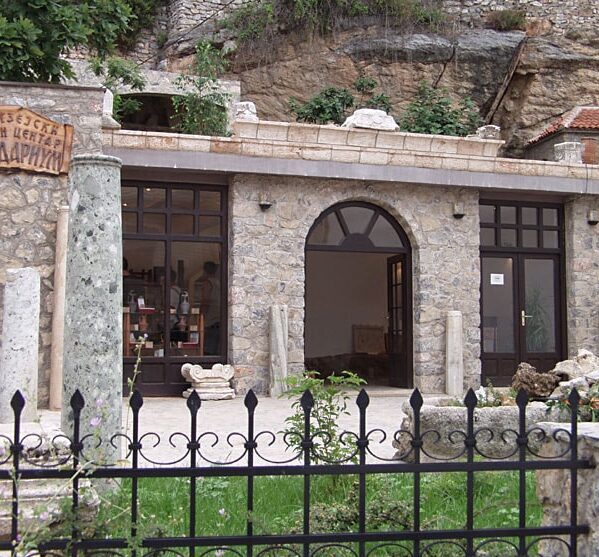
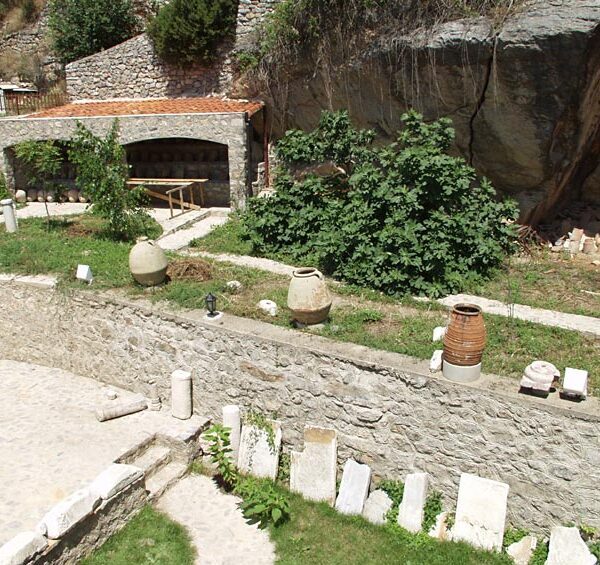
In 1955, the permanent exhibition of stone monuments – the Lapidarium – was opened, housed in an adapted stable of Kurshumli Andern museum space in the center of Skopje.
From 1963 to 1977, immediately following the catastrophic earthquake in Skopje in 1963, the Archaeological Museum was located in the barracks of Kurshumli An. In 1976, the new museum complex was opened, where the Archaeological Museum remained until 2014.
In 2012, a new legal entity was established, the National Institution Archaeological Museum of Macedonia – Skopje, as a new parent institution in the field of archaeology.
After more than three decades, in 2014, the Archaeological Museum of the Republic of North Macedonia was ranked among the 15 best museums in Europe, achieving a high seventh place according to the European Museum Academy.
Departments
Department of Ancient Archaeology
The Department of Ancient Archaeology collects, processes, studies scientifically and professionally, and presents museum artifacts originating from the ancient period in Macedonia – from the beginning of the Classical period (the second half of the 5th century BC) to the end of Antiquity (6th century).
The ancient period in Macedonia is a key stage in the formation of the main components of the civilizational and cultural matrix of the population in the wider Mediterranean region. During and after the conquests of Alexander III of Macedon, Macedonia became the most powerful factor in shaping the history of the entire known world.
In the subsequent period, Macedonia served as a crossroads between the eastern and western halves of the Roman Empire, a foundation for the differences and similarities of yet another world empire, which retained its strength throughout the Early Christian period and thus entered into the turbulent events of the Middle Ages.
All these historical achievements, as collective memory, are reflected in the archaeological artifacts studied by the Department of Ancient Archaeology at the National Archaeological Museum of the Republic of North Macedonia.
Department of Interdisciplinary Research
The Department of Interdisciplinary Research collects, processes, studies professionally and scientifically, and presents archaeological material that requires a specific working methodology, special conditions for storage and deposition, and a particular approach to conducting field research.
The Department of Interdisciplinary Research includes the following museum collections: Epigraphy and Stone Sculpture, Numismatics (ancient and medieval), Anthropology, and Archaeozoology.
Each of these collections encompasses archaeological and museum material originating from a wide chronological span, covering all periods from Prehistory to the Middle Ages.
Department of Conservation and Restoration
The primary activity of the Conservation Department is the conservation and restoration of movable archaeological heritage. The laboratory conserves and restores various objects made of metal, ceramics, glass, and stone, mainly from the museum’s own collection and, depending on capacity and significance, also conserves materials from other institutions in the Republic of North Macedonia.
The conservation of objects is carried out by professional conservators–restorers from the field of fine arts and chemical technicians. In addition to its primary activities, the laboratory traditionally cultivates the production of souvenirs and replicas of some of the exhibits.
The department exchanges experience with related institutions in the field of restoration and conservation of archaeological objects, including institutes, conservation centers, and laboratories both domestically and abroad.
Emilija Miteva – Head of the Department of Conservation and Restoration
📧 emilijamiteva17@gmail.com
Department of Museum Documentation
The Documentation Department is responsible for the basic museum documentation (entry book, inventory book of museum objects, exit book, exhibition book, card index, and catalog of museum objects) as well as the supplementary museum documentation (book for the safekeeping of museum objects not owned by the museum, newspaper archive, and book for promotional and other events).
The department also preserves reports from archaeological research projects, field documentation maintained by museum staff, photographic documentation, various drawings, and textual notes related to the objects and their archaeological context.
Nikola Hadži–Nikolov – Head of the Department of Documentation
📧 nhadzinikolov@amm.org.mk
Department of Prehistoric Archaeology
The Department of Prehistoric Archaeology consists of five complex collections that chronologically cover the longest period of human existence. Archaeological objects made from a wide variety of materials provide a picture of the development and continuity of prehistoric cultures on the territory of Macedonia, spanning 7,000 years—from the Neolithic period to the Iron Age.
The earliest traces of human existence are evident in the material remains of the Paleolithic collection, corresponding to the Late Middle Paleolithic, around 50,000 BC. Among the material culture preserved in the department, a special place belongs to Neolithic ceramics, which reached full bloom during the Developed Neolithic.
The beliefs and spiritual heritage of Neolithic and Eneolithic populations are reflected in numerous cult objects, altars with anthropomorphic and zoomorphic representations, figurines, and similar artifacts. The turbulent events of the 2nd millennium BC, which left strong marks on material culture, are illustrated by objects from the Bronze Age collection.
Of exceptional importance are the studies and research in this department related to the Paeonian communities, with special emphasis on objects from the group known as the “Macedonian–Paeonian Bronzes.” Distinguished by their unique artistic expression, these artifacts represent original and distinctive items of great significance for the prehistoric Iron Age culture in Macedonia.
Department of Medieval Archaeology and the Ottoman Period
The Department of Medieval Archaeology at the National Archaeological Museum of the Republic of North Macedonia represents the most vital period in the social and historical development of human society, when events were no longer traced in millennia and centuries, as in earlier cultures, but rather in decades, years, and even months.
The historical periods studied within the department and presented in the corresponding part of the exhibition, deeply intertwined with the phases of cultural development, cover the most dynamic segment of human existence in terms of history, politics, administration, religion, material, and spiritual culture.
For this reason, the department is divided into distinct periods: Early Byzantine, Early Medieval, Middle Byzantine, Late Medieval, and the Ottoman period—each of them marked by its own particularities, identity, and integrity.
In this sense, essential importance is given to the emancipation of the individual and their active role in everyday life, participation in regional economic, trade, military, social, religious, and cultural events, all driven by the ambition to be a creator of both personal and collective prosperity.
Thus, this inherent human activity, richly documented through written sources and traced through archaeological remains, must be presented through a wide spectrum of diverse forms—first within the framework of global historical periods, and then through the subtle cultural manifestations defined by the characteristics of material and spiritual culture.
Marketing and Public Relations
Primary goals of the Department of Marketing and Public Relations
- Development and implementation of a communication strategy aimed at improving the museum’s presence and visibility across social media, the website, media, and online portals.
- Identification of indicators for measuring and evaluating the effectiveness of all communication activities.
- Coordination and logistics for the promotion of exhibitions, conferences, and other events.
- Organization of events and protocol.
- Development and implementation of a plan for improving and regularly updating the museum’s website.
- Preparation of communication materials such as press releases.
- Implementation of activities and projects that build and maintain the institution’s positive public image.
- Establishing and maintaining partnerships with tourism professionals; preparation and implementation of cooperation agreements aimed at promoting the museum and increasing visits by foreign tourists.
- Participation in tourism fairs.
- Business communications and cooperation with other institutions, humanitarian organizations, and schools.
- Analysis and recommendations for branding, positioning, preparation, and printing of promotional materials.
- Planning the distribution of printed promotional materials.
- Monitoring sales and visitor feedback and satisfaction.
- Organization and implementation of the museum’s participation in international events.
Contact:
Marketing Advisor
MA Lidija Ilkovska Janusheva – lidijailkovska@gmail.com
Map
