Archaeo Park Brazda
Brazda lies 10 km north of the center of Skopje, at the southwestern foothills of Skopska Crna Gora. To the southwest of the village rises the isolated hill Gradište, 70 m higher than the surrounding terrain. Its northern and western slopes are very steep, while on the south and east the land descends in terraces.
At the northern foot of the hill, the small rivers Brazda and Gluška (Čučerska) converge. This water, once captured, was conducted southward and supplied the ancient city of Scupi and medieval Skopje with drinking water.
On the flattened top of Gradište, on its southern and southwestern slopes, lie the remains of a fortified early antique settlement (7th–4th century BC), arranged across several terraced platforms, covering an area of 4.5 hectares.
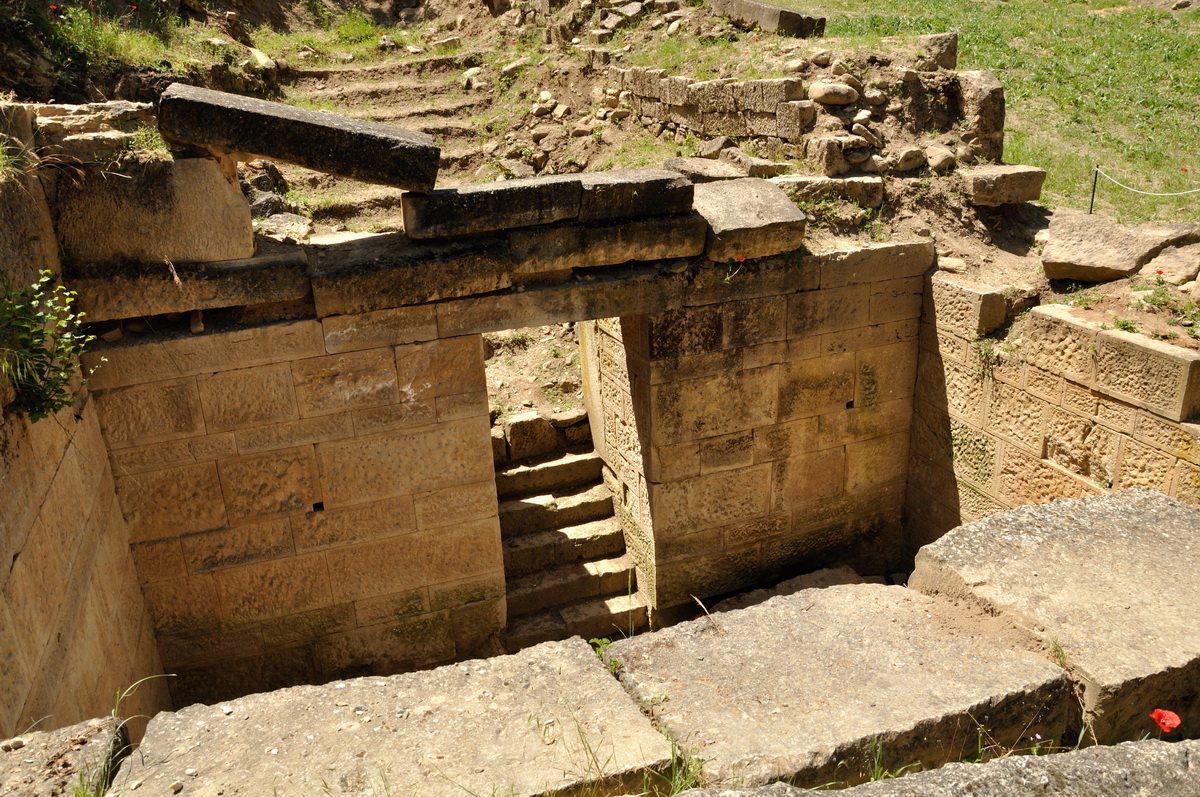
Several elements of its construction, purpose, and history are clear. By its function, the tomb was undoubtedly royal. This is indicated above all by its size, then by the quality of construction and the processing of its blocks, for which top architects were engaged.
It should be emphasized that the decorative travertine, built with a core of crushed stone and packed clay and finished stone faces, is Hellenic. The decorative barbotine technique, with slightly raised smooth frames, flat faces, and edges lying in the same plane, are features of Athenian architecture of the 5th and early 4th century BC. These elements clearly contrast with the features of the later, Hellenistic period, which began forming around the middle of the 4th century BC. The enumerated features, crucial for dating the tomb, are fully supported by the ceramics found, which are dated to the same time.