Golemo Gradishte, Konjuh
Late Antique fortified city in the region of Kratovo.
The archaeological site of Golemo Gradishte is located near the village of Konjuh, Kratovo. It is known as a rare example of a town built at the end of the 5th or early 6th century AD on the territory of the province of Dardania in the Eastern Roman Empire. Itspreads over a long, high acropolis, a wide terrace on the northern foothill of the acropolis, surrounded by the Kriva River, and a narrower area on the southern foothill of the acropolis.
The city is an example of the late phase of Roman urbanism, with strong fortifications and significant emphasis on church architecture. The plan of the city, fortress and churches also represents an early stage in the development of European urbanism and religious heritage. With its 17 hectares, Golemo Gradishte at the village of Konjuh is the largest and best explored 6 th century city in the northeastern part of Macedonia.
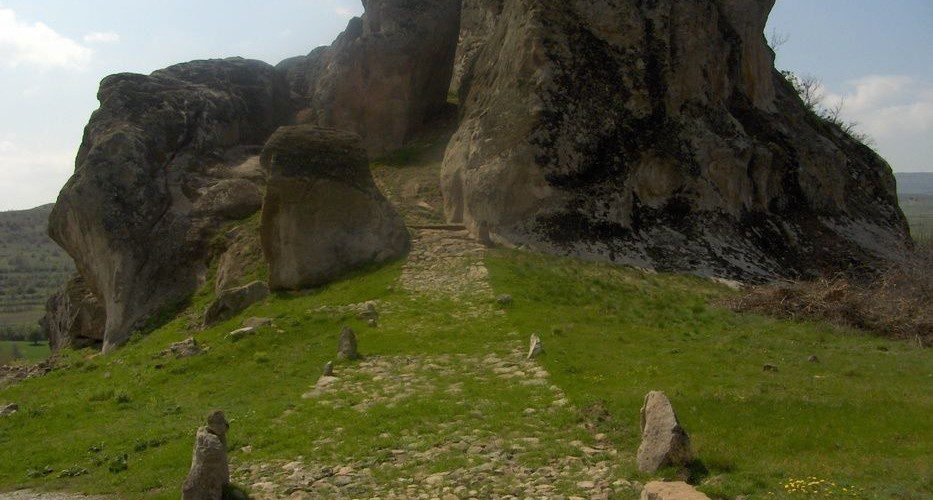
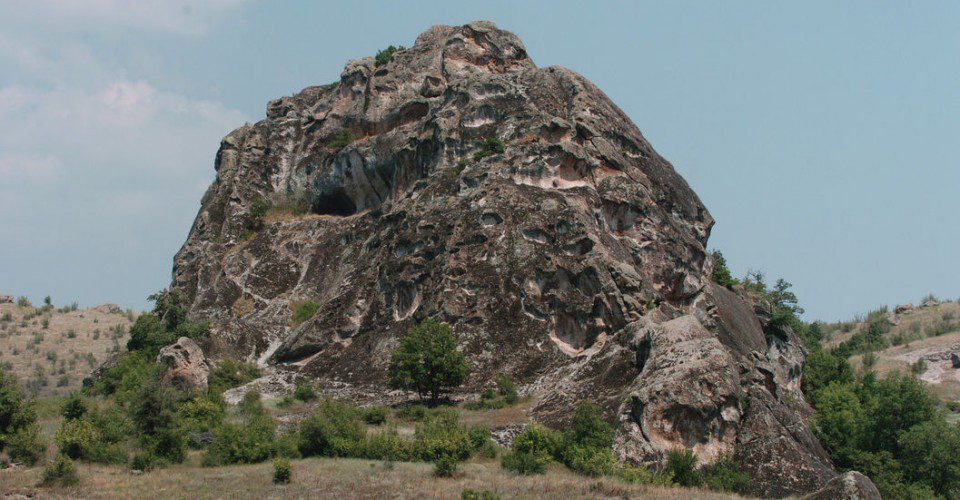
On the naturally protected acropolis on the high hill known as Golemo Gradishte, in the 6th century a strong fortress was built. Thanks to archaeological research, conducted between 1998 and 2004, gates, streets, stairs and several residential and public buildings with foundations dug into soft bedrock were discovered. Some of them, including a large cistern for water, are visible even today on the acropolis. The dominance of the hill above the wider
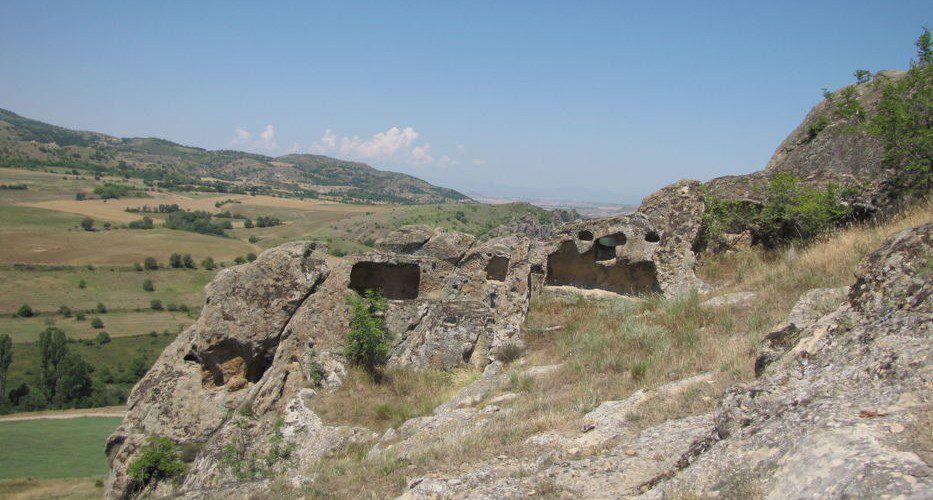
surroundings was of great strategic importance for the safety of the city and its residents in the turbulent times of the 6th century. The site is known for its variety of rooms and features carved into the rock on the southwest side of the hill. There is a tradition that in the past they were used as monastic cells.
From 2005 till today, systematic investigation has continued on the northern terrace, where two large residential housing complexes have been discovered. The first is a multi-purpose building with storerooms and workshops around an interior courtyard, while the second is a
residence with several large rooms, kitchen area and courtyard with a colonnade; it, undoubtedly belonged to a member of the urban elite. Between the two residences was discovered a great basilica (35 x 15 m), with various unusual architectural solutions. One of its annex rooms, with an eastern apse and a piscina, was identified as a baptistery. Fragments of stone sculpture, discovered in this basilica but also in the Rotonda church at the site, point to a local workshop from the mid-6th century.
Outside the walls of the fortified city cemeteries were established, of which the best explored is the K'shla necropolis on a plateau about 500 meters northeast of Golemo Gradishte. On the eastern slope of this plateau, during salvage excavations in 1995, a small basilica with a large tomb inside was discovered; it probably functioned as part of the necropolis. Also belonging to this site is the Rotonda church with its unique circular nave, discovered in 1919 on a knoll ca. 200 meters southeast of the city. The grand architectural elements and plans, as well as the number of churches, indicate the probability that the town was an episcopal seat. Its size, location and obvious economic strength identify the city as an important strategic and administrative center in the region during Late Antiquity.
Golemo Gradishte is the largest and so far the best investigated city of the 6th century in the northeastern part of Macedonia. The results of the investigations provide important information and conclusions about urbanization in this region and, more specifically, about the few cities newly created in Late Antiquity. The religious architecture is of exceptional value, not only for this site and our territory but also for the whole Balkan Peninsula. We have already mentioned the three churches from the 6th century, which with unique appearance and liturgical elements served the Christian community of the city in different ways. The beautiful reliefs of the ambos in the Rotonda and the Episcopal Basilica are until now without comparanda and also point to an unknown local workshop.
From the very beginning in 1998, the investigation of Golemo Gradishte was carried out as an international research project under the direction of the Archaeological Department of the NI Museum of Macedonia—today the NI Archaeological Museum of Macedonia, Skopje—and Gettysburg College in Gettysburg, Pennsylvania, USA.
M.A. Goran Sanev, senior curator archaeologist